Are shelter dogs more likely to have serious behavior problems? That is the question I set out to answer in January 2011, when I conducted a study as part of my graduate work on how often serious behavior problems show up in dogs based on where they came from: shelters, breeders, pet stores, and other sources.
As an avid rescuer, I hoped shelter dogs would not turn out to be more likely to have these problems, but I didn’t expect that result. Neither did the participants. Almost half (45.6%) said they believed shelter dogs were more likely to have serious behavior problems.
To my surprise, the study found no significant difference in serious behavior problems between dogs from shelters and dogs from breeders, pet stores, or other sources. It was a small study, 85 dog owners in New York City, so the results are a starting point, not the final word. But they match what I’ve seen in decades of rescue and behavior work: where a dog comes from tells you far less about its behavior than most people expect.
The full study is below. Feel free to skip the technical sections.
—
Frequency of Serious Behavior Problems in Shelter Dogs: Owner Perceptions and Reports
In 2009 there were approximately 77.5 million dogs living in homes in the United States, with 39% of households having at least one dog (American Society for the Prevention of Cruelty to Animals, 2009). The majority of dogs were obtained from acquaintances and family members, while only about 15% of dogs owned were adopted from a shelter (ASPCA, 2009; National Council on Pet Population Study and Policy, 1997). The American Society for the Prevention of Cruelty to Animals (2009) estimates that six million companion animals enter animal shelters nationwide every year, and about 3.5 million are euthanized. They also estimate that there is about an equal division between animals relinquished to shelters by owners and those picked up by animal control (ASPCA, 2009). More than 20% of people who relinquish their dogs to shelters adopted them from a shelter (NCPPSP, 1997). Five out of ten dogs in shelters are destroyed simply because there is no one to adopt them (ASPCA, 2009).
The low adoption rate nationwide may relate to the public’s perception that dogs from shelters have a higher rate of behavior problems than dogs with other origins, such as breeders or pet stores. A study by Wright, Smith, Daniel, and Adkins (2007) found that the public’s view of a shelter dog’s “adoptability” is directly influenced by perceived behavior problems. The purpose of the current study was to determine whether there is greater frequency of serious behavior problems (aggression and anxiety) in dogs from shelters compared to other origins, and to explore owner perception of the risk of behavior problems in shelter dogs.
Serious Dog Behavior Problems: Aggression and Anxiety
Aggression toward humans is one of the most frequent serious behavior problem reported by dog owners (Beaver, 1983; Hart & Hart, 1985). Behaviors that are considered to be aggressive include growling, barking, lunging, and biting other dogs or people (Goodloe & Borchelt, 1998). There are several categories of aggressive behavior, including dominance related (generally to family members), protective (generally to strangers), defensive (in the context of fear or perceived threat), predatory, and others (Askew, 1996; Beaver, 1983; Borchelt & Voith, 1982). Aggression by dogs toward other dogs is also common, but less frequent. (Askew, 1996; Beaver, 1983; Borchelt, 1983; Sherman, Reisner, Taliaferro & Hout, 1996). Anxiety is another serious behavior problem that is often reported by dog owners. Examples of anxious behavior include barking or crying excessively when left alone, destructive behavior, or obsessive behavior (Borchelt & Voith, 1982). None of the above studies have considered the frequency of serious dog behavior problems in relation to their origin, or public attitudes towards shelter adoption in relation to behavior.
Behavior History
A factor that may play a role in the behavior of a shelter dog once placed in a new home is the dog’s behavior history prior to entering the shelter. If serious behavior problems existed before the dog entered the shelter, those behaviors may continue post adoption. A Regional Shelter Relinquishment Study, sponsored by the National Council on Pet Population Study and Policy (1997), found that serious behavior problems such as aggression and anxiety were owners’ most frequently given reasons for the relinquishment of their dogs to shelters. This may account for why only approximately 25% of dogs that enter shelters in the United States are adopted, and approximately 3.5 million animals are euthanized (NCPPSP, 2007). A study by Stephen and Ledger (2007), on the other hand, noted that behavior problems reported by former owners upon relinquishment to a shelter were not consistently present post-adoption, and that owner reports should not be relied upon. Thus, it is unclear to what extent behavior problems in a shelter dog’s history are likely to continue post adoption.
Shelter Environment
Another factor that may influence the behavior of shelter dogs post-adoption is the impact that the shelter environment has on a dog’s physical and emotional health. The restrictive environment of a shelter, including the over-stimulation to the auditory, olfactory, and visual senses of the dog, has been found to be directly associated with poor dog welfare, and can have a negative psychological impact on a dog (Taylor & Mills, 2007). Poor sanitation, poor air quality, and over crowding can all lead to high stress levels for shelter dogs and spread illness (UC Davis Koret Shelter Medicine Program, n.d.). For example, one of the most common shelter illnesses is Canine Infectious Respiratory Disease Complex (CIRDC), commonly referred to as “Kennel Cough,” which is highly contagious and includes symptoms such as sneezing, nasal and ocular discharge, and sometimes lower respiratory and/or systemic disease (UC Davis Koret Shelter Medicine Program, n.d.). All of these physical and psychological factors could have an impact on the behavior of a dog once released from a shelter.
Breed Differences
The frequency of dog behavior problems may also be impacted by breed differences. A 2008 study by Duffy and Serpell found significant differences among breeds regarding aggression towards strangers, dogs and owners. For example, breeds such as Chihuahuas and Dachshunds scored higher than average for aggression directed towards both humans and dogs, while other breeds such as Akitas and Pit Bull Terriers scored high only for dog directed aggression. Breeds with the greatest overall percentage of serious aggression (bites or bite attempts) toward humans included Dachshunds, Chihuahuas and Jack Russell Terriers (toward strangers and owners); Australian Cattle Dogs (toward strangers); and American Cocker Spaniels and Beagles (toward owners) (Duffy & Serpell, 2008). Another study found a particularly high risk for aggression in English Cocker Spaniels and the Catalan Sheepdog, noting that aggression problems were the most common behavior complaint (52.28%) among the 1,040 dog behavior cases in the study (Fatjo, Amat & Mariotti, 2007).
Dogs coming from pet stores or breeders tend to be purebreds, of which there are over 150 recognized breeds (American Kennel Club, 2003). Around 15% of dogs in the United States are purchased from a breeder, and 25% of the dogs entering shelters are purebred (NCPPSP, 2007). If the remaining 75% of dogs in shelters are mixed breeds or breeds that are not recognized, then this may influence the frequency of behavior problems in shelter dogs compared to dogs with other origins.
From the above research, it is clear that there are many factors that may influence whether a dog in a shelter will have serious behavior problems once adopted, including the dog’s prior behavior history, the shelter environment and its mental and physical health impacts, and the dog’s breed. None of these studies addressed the frequency of serious behavior problems in dogs with different origins, or the attitude of the public towards adopting from shelters in light of the perceived risk of behavior problems. These are the questions that were addressed in this study.
Present Study
In the present study, 85 dog owners were given a questionnaire about their dog’s behavior and their personal attitudes towards shelter adoption. Owners were asked specific questions about the frequency and severity of any behavior problems, including aggression towards other dogs, aggression towards people, and anxiety. They were also asked where they got their dog (breeder, shelter/rescue, pet store, or other). We hypothesized that there would be a greater frequency of serious behavior problems in dogs coming from shelters, compared to dogs with other origins. This hypothesis was due to the fact that a large number of dogs are relinquished by owners to shelters due to such behavior problems (Salman et al., 2000), due to the psychological impact on a shelter dog by the shelter environment (Taylor & Mills, 2007), and due to the types of breeds in shelters (NCPPSP, 2007). Furthermore, we expected that the participants would have negative attitudes towards shelter adoption because they believe that dogs from shelters are more likely to have serious behavior problems than dogs with other origins.
Method
Participants
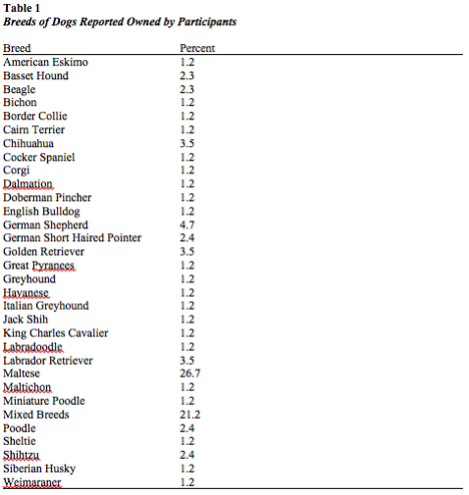
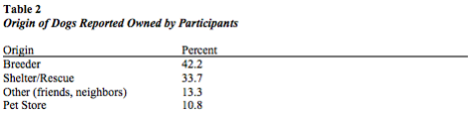
A convenience sample of 85 dog owners was used in this study. Participants were recruited either in person by the investigator at dog parks in New York City or through an online survey taken by friends, family and colleagues of the investigator. The dogs owned by the participants included a variety of breeds, comprising 76.6% purebred, and 21.2% mixed breeds (See Table 1). At the time the participants got their dogs, 74.6% of them were six months or younger. Forty two point two percent of the dogs came from breeders, 33.7% from shelters or rescue groups, 13.3% with other origins (friends, family, neighbors), and 10.8% from pet stores (See Table 2).
Materials and Procedure
This study was conducted through the use of a questionnaire that was given to participants (See Appendix A for the full questionnaire). The questionnaire consisted of 36 questions about the participant’s dog, including questions about breed, age when they got the dog, origin, behavior history and participant views towards shelter adoption. For example, participants were asked, “Where did you get your dog?,” and were given the option to answer between “pet store,” “professional breeder,” “shelter,” “rescue group,” or “other”.
Participants were asked about three categories of behavior in this study: aggression towards dogs, aggression towards humans, and anxiety. In the first and second categories, participants were asked whether their dogs ever growled, barked, lunged or bit other dogs or people. The answer choices available were “never,” “only once,” “rarely,” “sometimes,” “often,” and “daily”. In the anxiety category, participants were asked whether their dogs ever barked or cried when left alone, were destructive, or behaved obsessively. Again, answer choices were “never,” “only once,” “rarely,” “sometimes,” “often,” and “daily”.
Data was collected using two methods: in person collection by the investigator, and through an online survey given to friends, family, and colleagues of the investigator. In-person collection took place at a number of dog parks in New York City. The investigator observed people with dogs and approached them, asking if they were the dog’s owner. If they responded that they were the dog’s owner, they were invited to participate in the study. Only one person invited to participate in the study declined, and the remaining individuals filled out the questionnaire. None of the participants approached the investigator and requested to participate.
The sampling method with online survey participants included an email message sent to friends, family, and colleagues of the investigator, all of whom were dog owners. Individuals were invited to participate in the online survey and were provided a direct link to the website to complete the survey. Survey responses were compiled and input into a database, and the data was analyzed using the statistical analysis program SPSS.
Results
The dogs of the 85 participants in the study had the following origins: 42.2% from breeders, 33.7% from shelters or rescue groups, 13.3% with other origins (typically friends, family, or neighbors), and 10.8% from pet stores (Table 2). The dogs owned by the participants included a variety of breeds; 76.6% of which were purebred, and 21.2% were mixed breeds (See Table 1). At the time the participants got their dogs, 74.6% of them were six months or younger.
Aggression Towards Dogs and Humans
In the categories of aggression towards dogs, and aggression towards humans, owners were asked about the following behaviors: growling, barking, lunging and biting. In the anxiety category, participants were asked about barking and crying when left alone, destructive behavior, and obsessive behavior. Those participants responding that their dogs engaged in the behavior at issue “sometimes,” “often,” or “daily” were considered to have a behavior problem in that category for the purposes of this study.
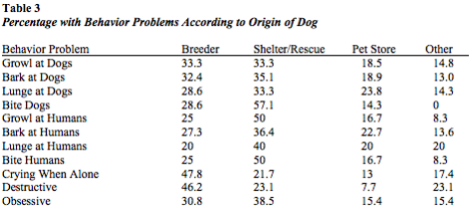
Reports of dogs with a problem of growling aggressively at other dogs were 33.3% for shelter/rescue dogs, 33.3% for dogs from breeders, 18.5% for dogs from pet stores, and 14.8% with other origins (See Table 3). For barking aggressively at other dogs, 35.1% of those with this problem were from shelters/rescues, 32.4% from breeders, 18.9% from pet stores, and 13% with other origins (See Table 3). Those indicating that their dog had a problem with lunging at other dogs aggressively included 33.3% from shelters/rescues, 28.6% from breeders, 23.8% from pet stores, and 14.3% with other origins (See Table 3). Finally, those participants reporting that their dogs had problems of biting other dogs included 57.1% from shelters/rescues, 28.6% from breeders, 14.3% from pet stores, and 0% with other origins (See Table 3).
Reports of growling aggressively at humans included 50% from shelters or rescues, 25% from breeders, 16.7% from pet stores, and 8.3% with other origins (See Table 3). Those with a problem of barking at humans were comprised of 36.4% from shelters or rescues, 27.3% from breeders, 22.7% from pet stores, and 13.6% with other origins (See Table 3). Reports of problems of biting humans included 50% from shelters/rescues, 25% from breeders, 16.7% from pet stores, and 8.3% with other origins (See Table 3). In the sub-category of lunging at humans, 40% of the dogs with problems in this area were from shelters/rescues, 20% from breeders, 20% from pet stores and 20% with other origins (See Table 3).
Anxiety
In the anxiety category, 47.8% of dogs from breeders, 21.7% of dogs from shelters or rescues, 17.4% of dogs with other origins, and 13% of dogs from pet stores were reported to cry or bark excessively when left alone (See Table 3). Those dogs reported to have destructive problems included 46.2% dogs from breeders, 23.1% dogs from shelters or rescues, 23.1% dogs with other origins, and 7.7% dogs from pet stores (See Table 3). Finally, dogs reported to have obsessive behavior problems were comprised of 38.5% shelter or rescue dogs, 30.8% breeder dogs, 15.4% dogs from pet stores and 15.4% dogs with other origins (See Table 3).
Owner Perception of Shelter Dog Behavior
Participants were asked if they considered the risk of behavior problems when choosing where they got their dog. The majority (53.6%) responded that it was not a factor in their decision. Just under half (45.6%) of participants believe that dogs from shelters or rescue groups are more likely to have behavior problems than dogs with other origins.
Analysis
A one way analysis of variance (ANOVA) was performed to examine whether there was an effect of dog origin on mean responses to behavior questions. There were four groups in the “origin” variable: shelter/rescue, breeder, pet store and other. The “behavior problem” variable had 11 groups: aggression towards dogs (growling, barking, lunging, biting), aggression towards humans (growling, barking, lunging, biting) and anxiety (crying when alone, destruction, and obsessive).
The ANOVA results revealed only a significant main effect in the aggression category of lunging at other dogs, F(3, 79) = 3.50, p = .019, h2 = .12, with a larger difference between dogs from pet stores (M = 3.33) and dogs from breeders (M = 1.83). The post-hoc Bonferroni analysis indicated that the difference between the means for lunging at other dogs, comparing dogs from a breeder with dogs from a pet store, was significant at the .05 level (p = .03). The 95% confidence interval around the mean difference (1.50) did not contain zero (.10 – 2.91). Therefore we can conclude that there is a .95 probability that the obtained confidence interval, 0.10 to 2.91, contains the true population mean difference.
There was no significant main effect in any other category of the ANOVA analysis. In the category of aggression towards dogs, the results were as follows: growling at dogs, F(3, 79) = 2.1, p = .102, h2 = .08; barking at dogs, F(3, 79) = 2.4, p = .076, h2 = .08; and biting dogs, F(3, 79) = .94, p = .426, h2 = .03. In the aggression towards humans category, the results were: growling at humans, F(3, 76) = 1.98, p = .124, h2 = .07; barking at humans, F(3, 76) = 2.21, p = .094, h2 = .08; lunging at humans, F(3, 76) = 1.69, p = .177, h2 = .06; and biting humans, F(3, 74) = .66, p = .582, h2 = .03. In the anxiety category, the results were as follows: crying when alone, F(3, 74) = .144, p = .933, h2 = .006; destructive, F(3, 73) = .902, p = .444, h2 = .04; obsessive, F(3, 72) = .749, p = .527, h2 = .03.
Discussion
Owner Reports of Dog Behavior Problems
The hypothesis that we tested in this study was whether dogs from shelters or rescue groups have higher rates of serious behavior problems than dogs with other origins. We expected to find that dogs from shelters and rescues would have higher rates of these behaviors. The findings of this study indicated that there was no significant difference in the frequency of serious behavior problems between dogs coming from shelters or rescues and dogs with other origins, and thus we failed to reject the null hypothesis. There was only a significant difference found in the aggression category with lunging at other dogs, with dogs from pet stores having a significantly higher rate of this behavior compared to dogs from breeders. However, the dogs from shelters and rescue groups did not have a significant difference between the means in that category, or in any other category.
Owner Perception of Shelter Dog Behavior
The second question in this study was whether people view the risk of behavior problems in dogs from shelters or rescues to be higher than with dogs with other origins. We expected to find that people would view the risk of such behaviors to be higher with dogs from shelters or rescues. The data showed that just over half of the participants responded that the risk of serious behavior problems was not a factor in their decision of where to get their dog. Just under half of participants believe that dogs from shelters or rescue groups are more likely to have behavior problems than dogs with other origins. That belief, however, was not consistent with the results of this study, which showed no significant difference in the frequency of serious behavior problems based on the dog’s origin.
Relevance of Study
This result is important because if this sample is representative of the population of dog owners in New York City, then it could form the basis for a very convincing argument in favor of shelter adoption. Since about half of the participants believe that shelter dogs have a higher risk of serious behavior problems, but the data showed that in actuality they were no more likely than dogs with other origins to have such issues, this data could change the overall perception of shelter dogs across the country. This could lead to higher adoption rates, and lower rates of euthanasia.
Limitations / Future Studies
The data in this analysis does have limitations that could be adjusted in future studies. This study only considered certain serious behaviors: aggression towards dogs, aggression towards humans and anxiety. These behaviors were chosen because they appear to be among the most difficult to treat and disruptive to dog owners’ lives. However, a future study could include more types of behaviors to get a better overall understanding of the frequency and types of behavior problems in dogs with different origins.
Another limiting factor was the sample size. In this study we had 85 participants, but this number could be expanded considerably in a future study to obtain more reliable data. In addition, the geographic scope of this study was limited to New York City, which could also be expanded. A study including participants in the entire United States would be ideal. This study did not take into consideration the age, breed and sex of the dogs, but these factors would be interesting to evaluate because they could play a role in leading to behavior problems.
The methodology used in this study was also limited, because information was obtained using a questionnaire created specifically for this study. We learned through responses to the questionnaire that some of the questions asked did not provide the participants with enough answer options. Thus, the phrasing of questions and answer options available could be amended in a future study. Another option would be to use an existing questionnaire used in a prior research study, or to change the method entirely by interviewing participants in person. An in person interview could result in more reliable data.
References
American Kennel Club (2003). Addition of Nova Scotia Duck Tolling Retriever. http://www.akc.org/news/index.cfm?article_id=1775
Askew, H.R. (1996). Treatment of behavior problems in dogs and cats. Cambridge, MA: Blackwell Science.
ASPCA, US Pet Ownership Statistics (2009). www.aspca.org/about-us/faq/pet-statistics.html
Beaver, B. V. (1983). Clinical classification of canine aggression. Applied Animal Ethology, 10, 3543.
Borchelt, P. L., & Voith, V. L. (1982). Classification of animal behavior problems. Symposium on animal behavior. Veterinary clinics of North America: Small animal practice (pp. 1- 585). Philadelphia, PA: W. B. Saunders.
Borchelt, P. L. (1983). Aggressive behavior of dogs kept as companion animals: Classification and influence of sex, reproductive status and breed. Applied Animal Ethology, 10, 45-6 1.
Campbell, W. E. (1975). Problem behaviors in dogs. Santa Barbara, CA: American Veterinary Publications.
Clifton, M. (2006). Dog attack deaths and maimings. Journal of Applied Animal Welfare Science, 3(2), 93–106.
Duffy, D., Hsu, Y., & Serpell, J. (2008). Breed differences in canine aggression. Applied Animal
Behaviour Science, 114(3-4), 441-460. doi: 10.1016/j.applanim.2008.04.006
Fatjo, J., Amat, M., Mariotti, V., de la Torre, J., & Manteca, X. (2007). Analysis of 1040 cases of canine aggression in a referral practice in Spain. Journal of Veterinary Behavior: Clinical Applications and Research, 2(5), 158-165. doi: 10.1016/j.jveb.2007.07.008
Goodloe, L. & Borchelt, P. (1998). Companion Dog Temperament Traits. Journal of Applied Animal Welfare Science, 1(4), 303-338.
Hart, B. L., & Hart. L. A. (1985). Canine and feline behavioral therapy. Philadelphia, PA: Lea & Febiger.
Landsberg, G. M. (1991). The distribution of canine behavior cases at three behavior referral practices. Veterinary Medicine, 86, 101 1-101 8.
National Council on Pet Population Study and Policy (NCPPSP) (1997). www.petpopulation.org
Salman, M.D., Hutchison, J. Ruch-Gallie, R., Kogan, L., New, J.C., Jr., Kass, P., & Scarlett, J. (2000). Behavioral Reasons for Relinquishment of Dogs and Cats to 12 Shelters. Journal of Applied Animal Welfare Science, 3(2), 93-106.
Sheman, C. K., Reisner, I. R., Taliaferro, L. A., & Houpt, K. A. (1996). Characteristics, treatment, and outcome of 99 cases of aggression between dogs. Applied Animal Behavior Science, 47, 91-108.
Stephen, J., & Ledger, R. (2007). Relinquishing dog owners’ ability to predict behavioural problems in shelter dogs post adoption. Applied Animal Behaviour Science, 107(1-2), 88-99.
Taylor, K., & Mills, D. (2007). The effect of the kennel environment on canine welfare: A critical review of experimental studies. Animal Welfare, 16(4), 435-447.
UC Davis Koret Shelter Medicine Program (n.d.). Information Sheet, Canine Infectious Tracheobronchitis (Kennel Cough). www.sheltermedicine.com/portal/is_infectious_tracheobronchitis_canine.shtml#top3
Williams, N. & Borchelt, P. (2003). Full body restraint and rapid stimulus exposure as a treatment for dogs with defensive aggressive behavior: Three case studies. International Journal of Comparative Psychology, 16, 226-236.
Wright, J., Smith, A., Daniel, K., & Adkins, K. (2007). Dog breed stereotype and exposure to negative behavior: Effects on perceptions of adoptability. Journal of Applied Animal Welfare Science, 10(3), 255-265.
—
If your rescue dog is struggling with fear or anxiety, book a free intro call to see if my program is the right fit.